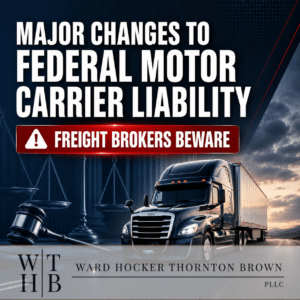
A recent decision by the Supreme Court of the United States (“SCOTUS”) has led to a major shift in liability for motor carriers and freight brokers.
As companies and even most individuals consumers likely know, given the ever-growing and necessary world of transportation and logistics, “[s]ellers often use motor carriers to transport products to their destination…[however,] finding a carrier can be time consuming, so many sellers rely on brokers to do it for them…Brokers are the transportation industry’s matchmakers, connecting sellers of goods to the carriers who move them.”
To put the importance of brokers into perspective, the SCOTUS cited that “roughly 28,000 brokers arrange transportation for about a third of all freight shipped in the United States by more than 780,000 carriers.” See Montgomery v. Caribe Transport II, LLC, et al., No. 24-1238, p. 1-2 (2026).
Montgomery decision
Earlier this month, on May 14, 2026, the SCOTUS issued a unanimous 9-0 decision in Montgomery, supra, which will increase lawsuits against freight brokers, again an increasingly important part of the transportation industry.
For more than two decades, the F4A safety exception had, in effect, shielded freight brokers from auto accident lawsuits in several federal circuits. The SCOTUS determined that Congress designed this safety exception “to ensure that its preemption of States’ economic authority over motor carriers of property [did] ‘not restrict’ the preexisting and traditional state police power over safety.” See Montgomery Opinion, p. 3 (citing Columbus v. Ours Garage & Wrecker Service, Inc., 536 U. S. 424, 439 (2002) (quoting §14501(c)(2)(A)) (emphasis added)).
Prior to the Montgomery decision, ambiguity surrounding some language of the safety exception of the Federal Aviation Administration Authorization Act (“F4A”) had led to a myriad of conflicting lower court opinions. See 49 U. S. C. §14501(c)(2)(A) (specifically the ambiguous language of “with respect to motor vehicles”). The Montgomery opinion, written by Justice Amy Coney Barrett, succinctly summarized the existing legal framework of the safety exception, the question at issue, and the Court’s decision, stating:
The Federal Aviation Administration Authorization Act preempts state laws related to the prices, routes, and services of the trucking industry. But there is an important exception: States retain authority to regulate safety “with respect to motor vehicles.” This case presents the question whether a claim that one company negligently hired another to transport goods falls within that exception. It does.
See Montgomery Opinion, p.1 (emphasis added).
For context and illustrative purposes, in the Montgomery case, a claim was brought for negligent-hiring against a freight broker, because, per the claimant’s pleadings, the motor carrier or driver had a “conditional” safety rating from the Federal Motor Carrier Safety Administration (“FMCSA”), as the FMCSA had found the motor carrier to be deficient “with respect to qualification of drivers,” “hours of service of drivers,” “inspection, repair and maintenance,” “recordable crash rate,” and more. This begged the question as to whether the freight broker, who had hired the motor carrier knew, or should have known, that selecting that motor carrier was reasonably likely to result in a motor vehicle accident that would injure others. See Montgomery Opinion, p. 3-4.
Here, the key to the clarification provided by the SCOTUS was stated as follows: “Montgomery [the claimant] argues that even if the FAAAA otherwise preempts his negligent-hiring claim against C.H. Robinson [the freight broker], the safety exception saves it. We [SCOTUS] agree.” See Montgomery Opinion, p. 4. In unanimously deciding on a broad interpretation of safety “with respect to motor vehicles,” the Court relied upon the ordinary meaning of the language and emphasized that common-law duties, and related standards of care, undoubtedly form part of a state’s authority to regulate safety. See Montgomery Opinion, p. 4-5 (citing to Restatement (Second) of Torts §411 (1964) (concluding that negligent-hiring claims impose a duty of reasonable care in employing a contractor for work carrying a risk of physical harm).
Looking Ahead
The Montgomery decision means federal law will not shield freight brokers from state-law negligent-hiring suits with respect to the interstate transport of goods. Given that much of the tort doctrines from the Restatement (Second) of Torts have been heavily cited in all fifty states, although adoption varies, freight brokers should take note and, going forward, seriously review the adequacy of their vetting procedures for selecting motor carriers and review their broker carrier agreements to include language defining the motor carrier as an independent contractor.
Should you have further questions about the implications of the Montgomery decision or require counsel on other automobile litigation issues, please contact us at Ward Hocker Thornton & Brown, PLLC. For decades, WHTB has proudly assisted clients from every stage of automobile litigation from pre-litigation claims up to and including jury trials and appeals. Our attorneys have a working knowledge of state and federal motor vehicle laws and duties imposed on motor carriers, brokers and drivers to evaluate potential liability. We counsel our clients in insurance coverage claims that may arise for no-fault, uninsured, and underinsured motorist benefits. We also assist clients in the retention of experts like accident reconstructionist and doctors, who may be needed to evaluate a claim.